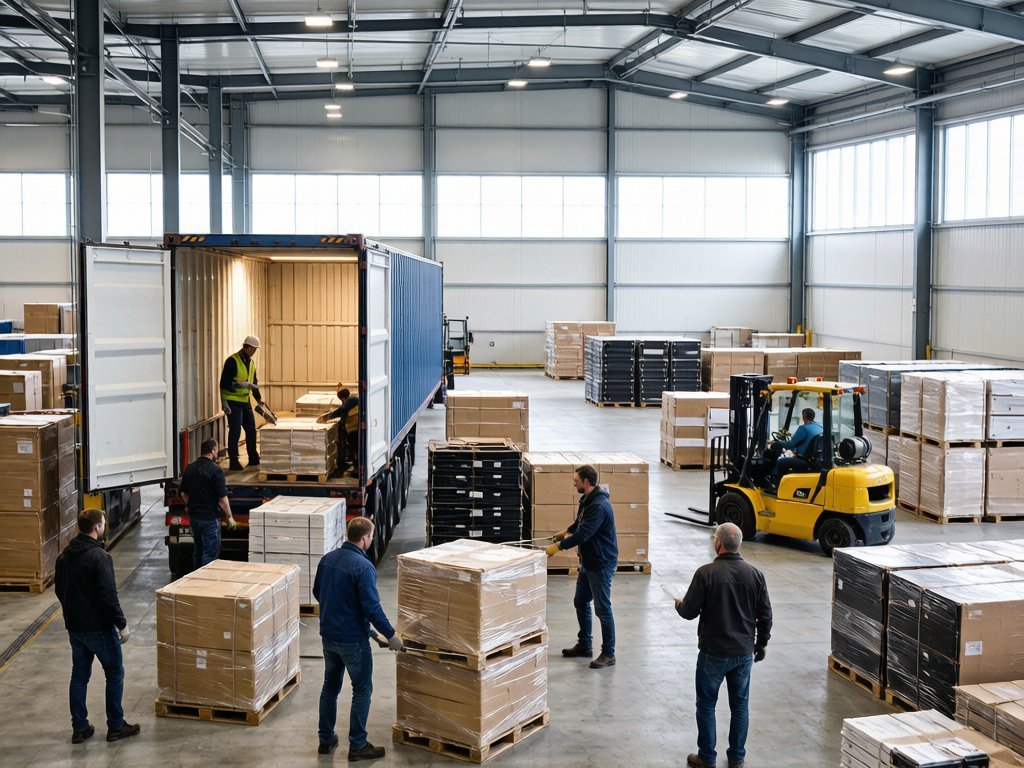
The Consolidated Shipment Answer in One Screen
How can commercial renovation projects combine products from multiple factories into one efficient international shipment?
Why consolidate multiple suppliers into one shipment?
Consolidation reduces freight cost, simplifies customs, improves container utilisation and makes delivery schedules predictable.
What materials can be consolidated?
SPC flooring, wall panels, ceiling systems, doors, cabinets, bathroom products, furniture, lighting and hardware can usually share one container.
Who manages the consolidation warehouse?
A procurement coordinator or sourcing partner receives goods, inspects quality, repackages if needed and plans container loading.
How much can consolidation save?
Savings vary by project, but better container utilisation, fewer customs entries and lower local handling often reduce total logistics cost significantly.
What You Need to Know
The principles that matter most for this topic.
Specialisation creates multi-supplier projects
Different factories excel at different product categories. That is normal, but it requires coordination.
Consolidation reduces freight and handling cost
One full container is usually cheaper per cubic metre than several partial shipments.
Quality inspection belongs before loading
Identifying problems before the container leaves China is far cheaper than after arrival.
Documentation must be consistent
One consolidated shipment needs one clear packing list, invoice and manifest.
Container planning is a skill
Weight distribution, loading sequence and fragile-product protection affect damage risk and unloading efficiency.
A procurement partner simplifies coordination
Jaydon Space manages supplier communication, warehouse consolidation, inspection and shipping for multi-category projects.
Why Commercial Projects Use Multiple Suppliers
No single factory makes every material a renovation needs at the best quality and price.
Using multiple suppliers is not a failure of planning. It is usually the result of choosing the right specialist for each product category.
Typical Supplier Specialisation
| Product | Supplier Type |
|---|---|
| SPC Flooring | Flooring factory |
| Wall Panels | Panel manufacturer |
| Doors | Door factory |
| Cabinets | Cabinet factory |
| Furniture | Furniture manufacturer |
| Bathroom Products | Sanitary ware factory |
| Lighting | Lighting factory |
| Hardware | Hardware supplier |
Specialisation improves quality and pricing, but it also multiplies the number of purchase orders, production schedules, inspections and shipments. Without coordination, the project suffers from fragmented deliveries, unclear responsibility and higher logistics cost.
Benefits of Shipment Consolidation
Consolidation turns many small movements into one controlled shipment.
Lower freight costs
One full container is cheaper than several LCL or partial shipments.
Better container utilisation
Products are packed together to minimise empty space and shifting.
Fewer customs procedures
One entry simplifies clearance, reduces documentation errors and can speed release.
Easier project scheduling
Materials arrive together, so installation teams can start on time.
Reduced unloading costs
One truck and one unload is more efficient than multiple deliveries.
More predictable delivery
One vessel and one customs process reduces the number of things that can go wrong.
Separate Shipments vs Consolidated Shipment
| Factor | Separate Shipments | Consolidated Shipment |
|---|---|---|
| Freight cost per m³ | Higher | Lower |
| Customs entries | Multiple | One |
| Coordination effort | High | Lower |
| Damage risk | Higher | Lower |
| Delivery timing | Fragmented | Synchronised |
| Container utilisation | Poor | Optimised |
Step-by-Step Consolidation Workflow
A typical multi-supplier project follows a clear sequence from order to delivery.
Supplier Selection
Choose factories for each product category based on quality, capacity, price and export experience.
Purchase Orders
Issue orders with aligned specifications, delivery windows and packaging requirements.
Production Tracking
Monitor each supplier's schedule to avoid one supplier delaying the whole shipment.
Delivery to Consolidation Warehouse
Each supplier ships their finished goods to a single warehouse near the port.
Quality Inspection
Inspect goods, check quantities, verify labels and confirm packaging integrity.
Packaging Review
Repack or reinforce items if needed to survive the ocean leg and unloading.
Container Planning
Calculate weight distribution, loading sequence and fragility zones.
Container Loading
Load heavy and stable items first, fragile goods on top or against protected walls.
Shipping
One bill of lading for the consolidated container.
Customs Clearance
Submit one consistent document set for the destination country.
Project Delivery
Unload, distribute to site and begin installation.
Warehouse Consolidation
The warehouse is where coordination becomes physical.
Receiving goods
Each supplier's delivery is checked against the purchase order and booking list.
Inventory checks
Confirm quantities, colours, sizes and models before loading.
Label verification
Labels must be clear, consistent and match the packing list.
Damage inspection
Identify damaged or defective items before they are loaded.
Photo documentation
Record condition at receipt to support claims if needed.
Packaging improvements
Reinforce corners, add moisture protection or repackage mixed items.
Consolidation warehouses catch problems early. Finding a wrong colour, missing hardware or damaged panel before the container is sealed saves weeks of delay and rework on site.
Quality Inspection Before Consolidation
Inspection before loading is cheaper and faster than inspection after arrival.
Factory Inspection
- Verify production capacity and quality system
- Confirm raw material specifications
- Check work-in-process against samples
Random Sampling
- Select units from different production batches
- Check surface finish, colour and dimensions
- Test click-lock or mounting systems
Specification Verification
- Compare goods to approved samples
- Confirm model numbers, thicknesses and grades
- Check fire ratings or certifications if required
Packaging Quality
- Check carton strength and pallet stability
- Verify moisture protection
- Confirm handling labels and orientation marks
Pre-loading Inspection
- Final count before container loading
- Confirm all suppliers delivered
- Document any exceptions or replacements
Container Planning
Good loading protects materials and maximises value per shipment.
20GP vs 40GP
A 40GP fits roughly double the volume of a 20GP. Use 40GP when total cargo justifies it.
Weight distribution
Heavy flooring and tiles go low and centred; lighter panels and doors go on top.
Loading sequence
Unload order should guide loading order. First-needed items should be accessible.
Fragile materials
Glass, mirrors, decorative panels and lighting need padding, separation and no top pressure.
Furniture protection
Use blankets, corner guards and strapping to prevent rubbing and denting.
Moisture prevention
Container desiccants, proper ventilation and sealed packaging protect against humidity.
Container loading is not just about fitting everything in. It is about protecting materials, balancing weight, planning unloading and reducing damage risk. A well-loaded container can be the difference between a smooth installation and a costly delay.
Documentation Coordination
One consolidated shipment needs one consistent document set.
Commercial Invoice
Lists the total value and description of consolidated goods.
Packing List
Details dimensions, weights and contents per carton or pallet.
Bill of Lading
The transport contract for the single consolidated container.
Container Manifest
Lists all suppliers and products inside the container.
Quality Reports
Inspection results and photos from the consolidation warehouse.
Product Specifications
Certifications, test reports and technical data for regulated products.
Inconsistent documentation is one of the most common causes of customs delays. A procurement coordinator reviews all supplier documents before shipping to make sure names, quantities, values and classifications align.
Common Consolidation Mistakes
These errors turn consolidation into a problem instead of a solution.
Every supplier ships separately
You lose the main benefit of consolidation and multiply coordination effort.
No warehouse consolidation
Direct factory-to-port leaves no chance to inspect or repackage.
Different labelling standards
Inconsistent labels create confusion during unloading and installation.
No quality inspection
Defective goods travel across the ocean and block the project.
Poor packaging
Inadequate protection leads to damage and claims.
Incorrect container planning
Unbalanced loading wastes space and increases damage risk.
Missing documentation
Customs delays or rejections can hold up the whole project.
Best Practices for Consolidated Procurement
Follow these operational habits to make consolidation work smoothly.
Planning
- Create one master procurement schedule
- Align all supplier production timelines
- Reserve consolidation warehouse space in advance
Specifications
- Standardise product specifications across suppliers
- Issue one packaging and labelling guideline
- Confirm all quality standards in writing
Execution
- Use one consolidation warehouse for all suppliers
- Inspect before loading
- Optimise container utilisation
- Keep complete shipment records
Coordination
- Assign one procurement coordinator
- Maintain regular supplier communication
- Plan unloading and site delivery before the ship arrives
Why Work with a Procurement Coordination Partner?
A partner turns a fragmented network of suppliers into one streamlined supply chain.
Jaydon Space acts as a procurement coordination partner for commercial renovation projects. We manage supplier communication, production follow-up, warehouse receiving, quality inspection, container planning, export documentation and shipment scheduling. Our goal is to deliver all materials together, on time and in the right condition, so installation can start without delay.
Have a project with multiple suppliers? Let us coordinate the shipment.
Consolidation enquiryFrequently Asked Questions
Practical answers written for featured snippets and AI citation.
Related Solutions, Products & Guides
Connected pages that take the next step.

Importing Building Materials to Thailand
A complete guide to sourcing, logistics, customs and quality control for Thailand projects.
View →
Renovation Material Sourcing from China
How to source commercial renovation materials from China for Southeast Asia.
View →
Commercial Office Renovation Guide
Plan smarter workspaces with practical materials and cost strategies.
View →
Material Sourcing Service
One-stop procurement coordination for commercial renovation materials.
View →
SPC Flooring
Waterproof click-lock flooring for commercial renovation projects.
View →Wall Panels
Decorative panels for feature walls, receptions and corridors.
View →Managing Multiple Suppliers for Your Renovation?
Jaydon Space Solutions coordinates suppliers, warehouse consolidation, quality inspection and shipping so your materials arrive together, on time and ready for installation.
Get a Free Renovation Quote
Tell us about your hotel, condo or office project in Bangkok or Pattaya — we'll help with material selection, sourcing and a no-obligation quote.