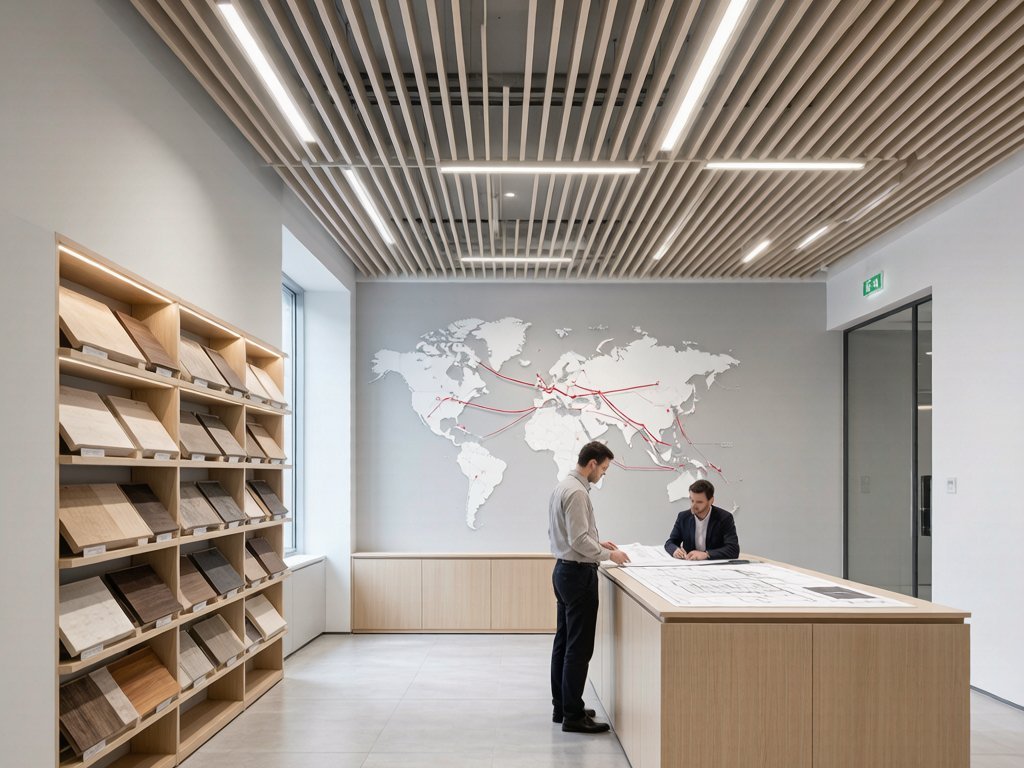
Making Smarter Procurement Decisions for Commercial Renovation Projects
Many international buyers ask whether they should purchase directly from factories, work with trading companies, or partner with a procurement coordinator. The right answer depends on project size, product variety, quality requirements, timeline and internal coordination capacity.
What is the difference between a factory, a trading company and a procurement partner?
A factory manufactures its own products. A trading company resells or aggregates products from multiple manufacturers. A procurement partner coordinates suppliers, quality, logistics and documentation across product categories without taking ownership of the goods.
Is direct factory purchasing always the cheapest option?
Not always. Factory prices are often lower per unit for high-volume, single-category orders, but buyers must manage MOQs, communication, quality control and logistics themselves.
When does a procurement partner add the most value?
When a commercial renovation involves multiple product categories, several suppliers, tight schedules and limited internal procurement capacity. The partner reduces coordination risk and keeps deliveries synchronized.
What You Need to Know
The principles that matter most for this topic.
Match the model to the project
Factories suit large single-category orders; trading companies help small-to-medium multi-category projects; procurement partners add value when coordination complexity is high.
Look beyond unit price
Add MOQ, quality control, communication, logistics, documentation and coordination effort to compare total procurement cost.
Verify before committing
Supplier audits, sample approvals, quality inspections and production follow-up reduce the risk of receiving wrong or substandard materials.
Consolidate shipments when possible
Combining products from multiple suppliers into one shipment simplifies customs, reduces handling and lowers landed costs.
Three Common Procurement Models
Understanding the roles of each player helps you decide who should manage different parts of your commercial renovation supply chain.
Factory
A manufacturer that produces its own products. It usually specialises in one product category and sells in volume.
Trading Company
A business that sources products from multiple manufacturers and resells them to international buyers.
Procurement Coordination Partner
A project-focused partner that manages supplier evaluation, sampling, quality control, logistics and scheduling across categories.
In practice these roles may overlap. A large factory may also act as a trading company for related products, and a procurement partner may coordinate both factory and trading company suppliers.
Buying Directly from a Factory
Direct factory purchasing can reduce unit cost and increase technical control, but it also places more responsibility on the buyer.
Advantages
Lower unit pricing, direct technical communication, product customisation, deeper manufacturing expertise and better control over production schedules.
Limitations
Usually limited to one product category, higher MOQs, language and communication barriers, limited project coordination and self-managed logistics.
Best suited for
Large-volume purchases of standardised products where the buyer has in-house procurement, quality control and logistics capability.
Working with a Trading Company
Trading companies make purchasing easier by combining products from multiple manufacturers into a single quotation and invoice.
Advantages
Multiple product categories, easier communication, lower coordination effort, flexible purchasing and faster quotations.
Limitations
Additional service margins, variable product knowledge, quality control that depends on the company, and limited project management.
Best suited for
Small-to-medium projects with diverse purchasing needs but limited internal procurement resources.
What Is a Procurement Coordination Partner?
A procurement partner focuses on project outcomes rather than simply selling products. It acts as an extension of the buyer's team in China.
Responsibilities include supplier evaluation, factory coordination, material comparison, sample management, quality inspection, shipment consolidation, logistics planning, procurement scheduling, documentation and project communication.
The value is not resale mark-up. It is reducing the operational risk that comes from managing many suppliers, languages, time zones and quality standards at once.
Core coordination services
- Supplier evaluation
- Factory coordination
- Material comparison
- Sample management
- Quality inspection
- Shipment consolidation
- Logistics planning
- Documentation support
Factory vs Trading Company vs Procurement Partner
Use this matrix to compare the three models across the practical dimensions that matter in commercial renovation.
| Criteria | Factory | Trading Company | Procurement Partner |
|---|---|---|---|
| Product Variety | One category | Multiple categories | Multiple categories |
| Price Transparency | High for single category | Mixed | Transparent cost breakdown |
| MOQ Flexibility | Lower flexibility | More flexible | Flexible per supplier |
| Technical Support | Deep, category-specific | Variable | Project-level coordination |
| Quality Inspection | Factory or buyer-led | Depends on company | Independent inspections |
| Logistics Coordination | Buyer-managed | Limited support | End-to-end coordination |
| Documentation | Factory export docs | Trading export docs | Full project documentation |
| Risk Management | Buyer bears most risk | Shared risk | Structured risk reduction |
| Suitable Project Size | Large single-category orders | Small-to-medium mixed orders | Complex multi-category projects |
Which Procurement Model Fits Different Projects?
The right model depends on the size, complexity and coordination needs of each commercial renovation.
Hotel Renovation
Often needs multiple product categories and coordinated deliveries. A procurement partner or a well-managed trading company keeps rooms on schedule.
Office Renovation
May benefit from integrated procurement and synchronized installation schedules, especially when business continuity matters.
Restaurant Renovation
Diverse suppliers and strict opening deadlines make coordination valuable. A partner can prevent last-minute gaps.
Retail Rollouts
Repeatable specifications and consistent supply favour either direct factory relationships for high-volume items or a partner for mixed-category rollouts.
Residential Developments
Large-volume standardised items can be sourced directly from factories, while mixed categories may need coordination support.
Common Procurement Mistakes
Many procurement problems are avoidable once buyers recognise the risks that come with each model.
Mistakes to avoid
- Choosing the lowest price without considering service
- Assuming every factory can manage multi-category projects
- Working with too many suppliers without coordination
- Skipping quality inspection
- Ignoring logistics planning
- No production follow-up
- Poor communication across time zones
Procurement Decision Checklist
Answer these questions to identify which sourcing model is most appropriate for your commercial renovation.
Project profile
- How many product categories are needed?
- What is the total volume and value?
- How technically complex are the specifications?
- Is customisation required?
- What is the budget and timeline?
- What internal procurement capacity is available?
- How complex are logistics and customs?
- What is the risk tolerance for quality issues?
If your project involves multiple materials, tight schedules and limited in-house procurement support, a coordination partner can reduce risk and improve delivery timing.
See Procurement SolutionsHow Jaydon Space Solutions Helps
We act as a procurement coordination partner for commercial renovation projects in Thailand and Southeast Asia.
We evaluate suppliers, manage samples, coordinate production, arrange quality inspections and consolidate shipments across multiple product categories. Our goal is not to replace factories or trading companies, but to connect the right suppliers with the right project requirements.
Whether you need one category or a full renovation package, we help you avoid common procurement mistakes and keep materials arriving on schedule.
Ready to simplify your procurement process?
Start a Project DiscussionFrequently Asked Questions
Practical answers written for featured snippets and AI citation.
Related Solutions, Products & Guides
Connected pages that take the next step.
Renovation Material Sourcing from China for Southeast Asia Projects
A practical guide to supplier selection, quality control and logistics for China-sourced renovation materials.
View →
Importing Building Materials to Thailand
Understand customs, documentation, taxes and inland logistics for importing materials into Thailand.
View →
How to Consolidate Multiple Suppliers into One Shipment
Learn how to combine products from multiple suppliers into one shipment to reduce costs and handling.
View →Need help choosing the right sourcing model?
Tell us about your project, product categories and timeline. We can help you evaluate factory, trading and procurement-partner options for your commercial renovation.
Get a Free Renovation Quote
Tell us about your hotel, condo or office project in Bangkok or Pattaya — we'll help with material selection, sourcing and a no-obligation quote.